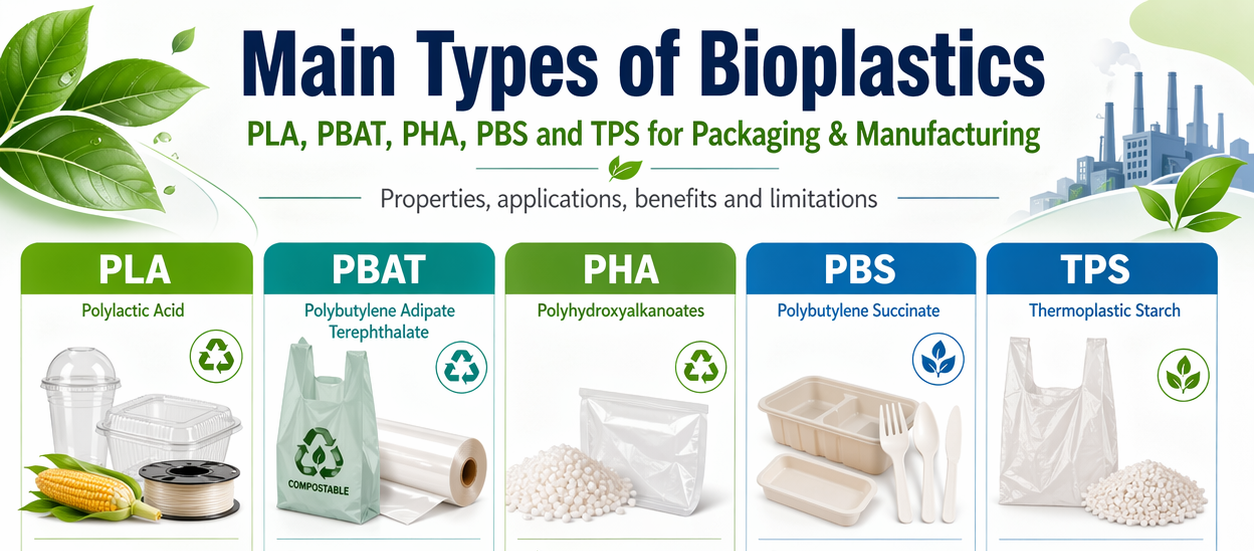
Bioplastics are becoming one of the most important material categories in sustainable packaging and eco-friendly manufacturing. As more businesses move away from traditional petroleum-based plastics, many buyers want to understand the types of bioplastics available and which one is best for their product, process, and market requirements.
There is no single bioplastic that works best for every application. Some are better for rigid packaging, some are better for flexible film, and some are better for compostable applications. That is why many manufacturers first compare the most common biodegradable raw materials before selecting the right grade.
What are bioplastics?
Bioplastics are plastic materials that are either bio-based, biodegradable, or both. In simple words, bioplastics are materials designed to reduce dependence on fossil-based plastics and support more sustainable product development.
However, not all bioplastics are the same. Some are made from renewable sources but are not fully biodegradable. Others are biodegradable or compostable under specific conditions. Because of this, material selection must be based on real performance, not just general sustainability claims.
Are all bioplastics biodegradable?
No, not all bioplastics are biodegradable.
This is one of the biggest misunderstandings in the market. A material can be bio-based but not biodegradable, and a material can be biodegradable without being fully plant-based. That is why buyers should always check the exact material type, formulation, and intended disposal route.
When comparing bioplastics, it is important to understand:
- whether the material is bio-based
- whether it is biodegradable
- whether it is industrially compostable
- swhat applications it is designed for
- what processing method it supports
PLA is often selected when appearance and shape retention are important. It performs especially well in rigid applications such as trays, cups, lids, blister packs, and certain food packaging formats.
Main types of bioplastics
The most common types of bioplastics used in packaging and manufacturing include:
- PLA
- PBAT
- PHA
- PBS
- TPS
Each of these materials has different strengths, limitations, and end-use advantages.
-
PLA bioplastic
PLA stands for Polylactic Acid. It is one of the most widely used bioplastics in the world and is commonly selected for rigid packaging applications.
PLA is made from renewable resources such as corn starch or sugarcane and is often used in trays, cups, lids, clamshell containers, and 3D printing applications.
Main benefits of PLA
- plant-based origin
- good transparency and gloss
- good stiffness
- good printability
- suitable for thermoforming and rigid packaging
Main limitations of PLA
- limited heat resistance in standard grades
- more brittle than flexible materials
- may not be ideal for soft film applications without blending
If your application needs rigid sustainable packaging, you can explore our PLA pellets for sustainable packaging for more product details.
-
PBAT bioplastic
PBAT stands for Polybutylene Adipate Terephthalate. It is a flexible biodegradable plastic commonly used in films, bags, and soft packaging applications.
PBAT is often used in compostable bag formulations because it provides flexibility, elongation, and toughness. It is also frequently blended with PLA or starch to improve performance.
Main benefits of PBAT
- high flexibility
- good toughness
- good stiffness
- good for bags and soft packaging
- useful in blend formulations
Main limitations of PBAT
- not as rigid as PLA
- often used as part of a blend rather than alone in many applications
- performance depends on formulation and process
For flexible packaging projects, many manufacturers use biodegradable PBAT as part of their material solution.
-
PHA bioplastic
PHA stands for Polyhydroxyalkanoates. It is a family of biodegradable polymers produced by microorganisms. PHA is often seen as an advanced bioplastic because of its biodegradation profile and specialty application value.
PHA is used in sustainable packaging, disposable items, and selected higher-value applications where biodegradability and bio-based positioning are especially important.
Main benefits of PHA
- biodegradable material family
- bio-based origin
- suitable for compostable and specialty applications
- useful for high-value sustainability-focused products
Main limitations of PHA
- usually more expensive than mainstream options
- supply and commercial use may be more limited than PLA
- application choice depends on grade and formulation
If you are exploring premium compostable material solutions, you can also review our PHA pellets for packaging applications.
-
PBS bioplastic
PBS stands for Polybutylene Succinate. It is another biodegradable polymer used in packaging and industrial applications. PBS is known for balanced mechanical properties and is sometimes used where flexibility and durability are both required.
PBS may be used in films, disposable products, agricultural applications, and blend systems. It is not always as commonly discussed as PLA or PBAT, but it remains important in the broader biodegradable polymer market.
Main benefits of PBS
- balanced performance
- biodegradable profile
- useful in packaging and industrial applications
- can support flexible product development
Main limitations of PBS
- less widely recognized than PLA in mainstream packaging discussions
- application suitability depends on grade and formulation
-
TPS bioplastic
TPS stands for Thermoplastic Starch. It is a starch-based biodegradable material used in packaging, disposable items, and compound blends. TPS is often selected because of its renewable origin and cost-supporting role in formulations.
TPS is frequently blended with other materials such as PLA or PBAT to balance cost, biodegradability, and performance.
Main benefits of TPS
- renewable starch-based content
- biodegradable potential
- useful in compound and blend systems
- helpful for cost-sensitive applications
Main limitations of TPS
- performance depends heavily on formulation
- moisture sensitivity can be an issue in some uses
- often better in blends than as a standalone material
If you want to learn more about starch compounds, you can also explore our starch-based biodegradable pellets.
Comparison of common bioplastics
When comparing the main types of bioplastics, the choice usually depends on the end use.
For rigid packaging
PLA is often one of the strongest options because of its stiffness, gloss, and shape retention.
For flexible bags and films
PBAT is usually more suitable because of its softness and flexibility.
For premium biodegradable solutions
PHA can be attractive for brands seeking high-value sustainable material positioning.
For cost-sensitive renewable blends
TPS is often used in formulations where starch content helps support a lower-cost biodegradable solution.
For balanced biodegradable performance
PBS may be considered in applications where durability and flexibility both matter.
Which bioplastic should you choose?
There is no universal answer. The best material depends on:
- whether the product is rigid or flexible
- the required processing method
- barrier and strength needs
- heat resistance requirements
- compostability expectations
- target export market rules
- budget and formulation goals
For example:
- choose PLA for trays, cups, lids, and rigid packaging
- choose PBAT for bags, films, and flexible packaging
- choose PHA for premium biodegradable solutions
- choose TPS for starch-based compound development
- choose blends when you need more balanced performance
Why buyers compare bioplastics before placing an order
A good buyer does not select a material based on one keyword alone. Instead, they compare performance, sustainability positioning, process compatibility, and end-market requirements.
That is why educational pages about bioplastics can bring high-quality traffic. They help manufacturers, importers, and converters understand what they need before requesting a quotation.
Why work with Samcome
At Samcome, we support businesses looking for practical biodegradable raw material solutions for packaging and manufacturing. We provide materials such as PLA, PBAT, PHA, TPS, and compound blends for different applications.
If you are comparing grades for films, trays, injection molding, or compostable products, you can request a quote and our team can help recommend the right option.
Conclusion
Understanding the types of bioplastics is the first step in choosing the right sustainable material. PLA, PBAT, PHA, PBS, and TPS all have different strengths and are used in different applications. The best choice depends on the product design, processing method, and market requirement.
By comparing these materials carefully, businesses can select a solution that supports both performance and sustainability goals.
Request a quote
Tell us your target product (film/bags, trays, injection parts), and we’ll recommend a suitable grade and provide a quotation.
FAQs "Most important questions that has been asked"?
What are the main types of bioplastics?
The main types of bioplastics commonly discussed in packaging include PLA, PBAT, PHA, PBS, and TPS.
Are all bioplastics biodegradable?
No. Some bioplastics are bio-based but not fully biodegradable, while others are biodegradable or compostable under specific conditions.
Which bioplastic is best for rigid packaging?
PLA is often one of the best-known options for rigid sustainable packaging.
Is PLA better than normal plastic?
PBAT is commonly used in flexible compostable bags and film applications, often in blend systems.
Which bioplastic is best for compostable bags?
PBAT is commonly used in flexible compostable bags and film applications, often in blend systems.
What is TPS in bioplastics?
TPS means Thermoplastic Starch, a starch-based biodegradable material often used in compounds and blends.